Serious Games
Put knowledge under pressure
Bedrock’s serious games put people in the decision seat. They weigh tradeoffs, commit under uncertainty, face an opponent with its own plan, and see the consequences within minutes. Every decision is recorded against the same competency model as Bedrock’s courses and intelligence.
- 78%of servicemembers think wargaming is important for their careers
- 11%of servicemembers think the armed services give them enough opportunities to play wargames
Judgment is built through repetition
Most professionals get very few chances to practice consequential decisions before the real ones arrive. A well-designed game supplies the repetitions: a hard problem, limited resources, an opponent who adapts, and an outcome the player has to own. A lost game costs minutes, and it is often where the lesson lands.
Practice against someone who pushes back
A plan on paper never argues. A human opponent, or one authored from adversary doctrine, exposes the fog, friction, and untested assumptions a briefing hides.
Understand why the decision was hard
Remember it
Players keep working the problem after the game ends.
Every decision becomes evidence
Bedrock records what players decide and what happened next. The record feeds an After Action Review and Capability Analytics, so leaders can see judgment alongside knowledge.
Decisions are committed on the record
Each carries a stated confidence and whether it can be reversed. Players can attach their reasoning and sources.
Outcome and plan quality are scored separately
A team can win with a weak plan or lose with a sound one, and leaders see both.
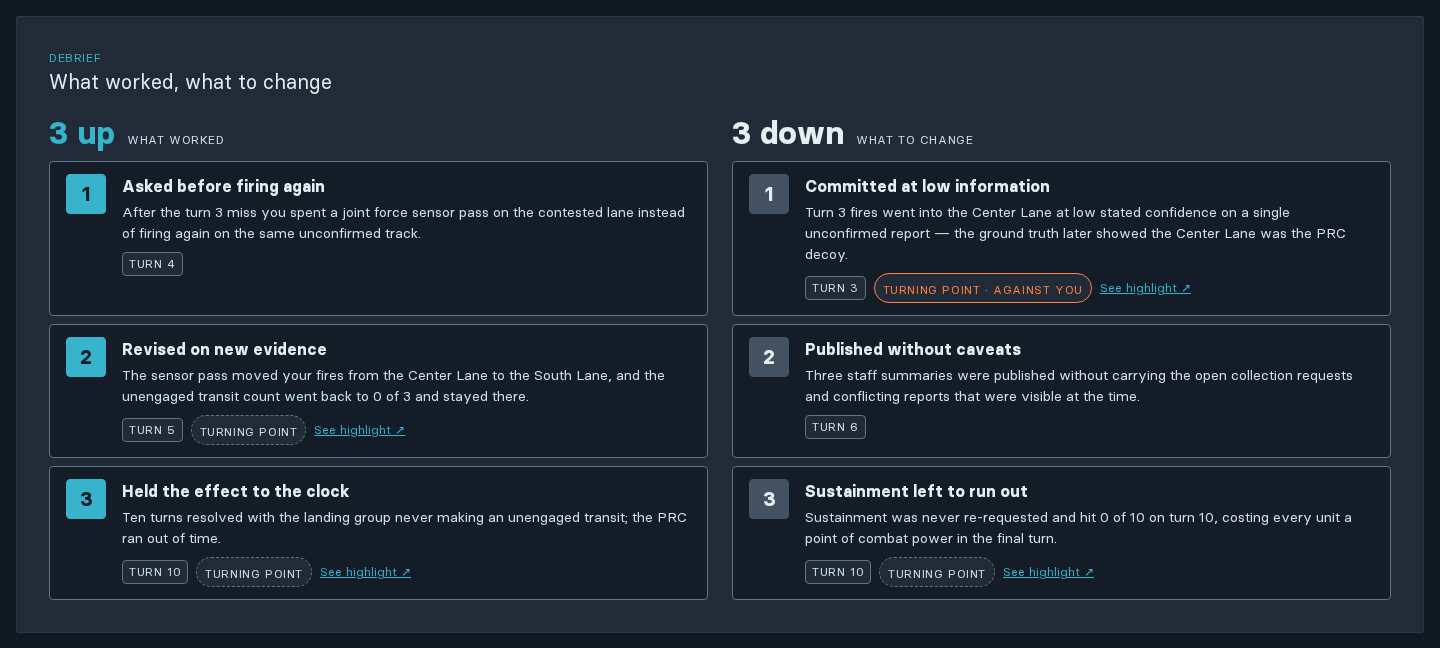
The debrief replays the game against ground truth
Players are never judged on information they did not have at the time.
Teaching moments are tied to specific decisions
Examples include committing early on thin information, holding too long, ignoring a contradiction, and carrying an untested assumption.
Records flow to Bedrock’s xAPI learning record store
From there they reach Capability Analytics and your LMS or HR systems.
The Bedrock game library
Every license includes every game. Each one is built around a stated learning objective. We build at least two new games every month and can adapt quickly to meet customer needs. A sampling of our games:
Position of Advantage
Plan and fight as the staff of a Marine Littoral Regiment defending a six-island strait against a PRC joint landing. The plan you build sets how the fight plays out.
Chokepoint
Competing U.S. and PRC blockades in a Taiwan crisis, where each side works to break the other’s will to fight.
The Red Line
Make commitments, signal resolve, and manage what happens when a threat is tested.
Iteration
A drone warfare adaptation race against an opponent who learns as fast as you do.
Arsenal
Run the U.S. defense industrial base through a fictional 2032 U.S.–China conflict, with munitions programs drawn from sourced data.
Red Team Cyber
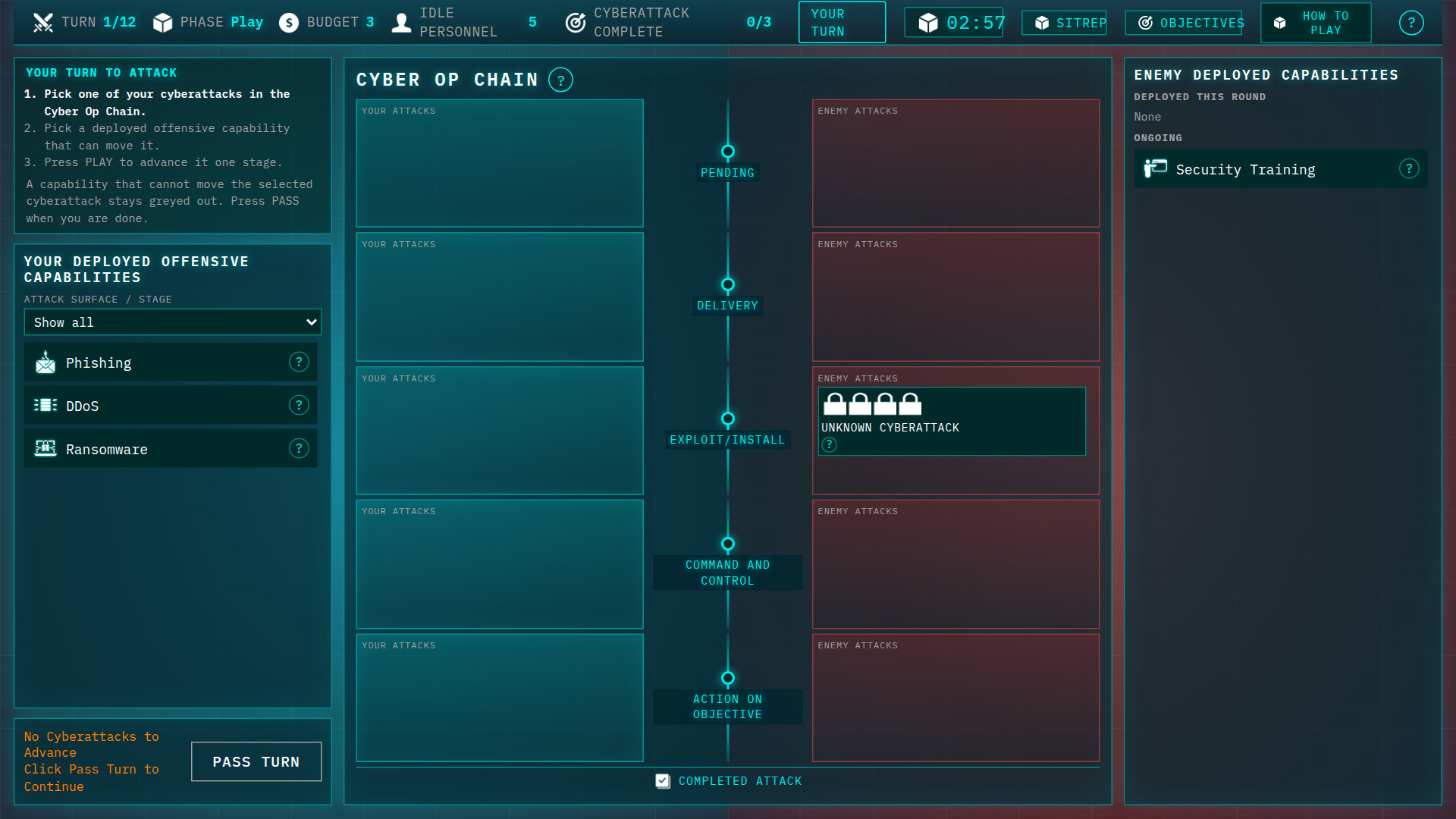
Attack and defend across five stages of a cyber operation.
Struggle for Syria
Play as one of any of the patrons or proxies (US, Russia, Turkey, Free Syrian Army, YPG, and even ISIS) in the Syrian Civil War against opponents.
Play alone, head to head, or as a team
In spare minutes
Single-player modes against a doctrine-authored opponent.
Head to head
Compete against colleagues in the same scenario.
As a seminar capstone
Pair a course and current intelligence with a game, then close with an after-action review of each team’s strategy.
Facilitated
Bedrock’s designers run a game with your team and walk leaders through the evidence it produced.
One cycle of learning
Wargaming scholar Peter Perla calls it the “cycle of learning”: study, exercise, and experience reinforce one another. In Bedrock, a course builds the concepts, intelligence keeps them current, and a game tests them. All three report to the same competency model.
Need a scenario of your own?
The Serious Game Engine will let your team build and run multiplayer scenarios that write evidence to the same learning record.
Frequently asked questions
How long does a game take?
Many Bedrock games play in about 30 minutes. Larger scenarios can run across a session.
Do we need a facilitator?
No. Players can start on their own. Bedrock can also facilitate sessions for your team.
Where do results go?
To Bedrock’s xAPI learning record store and Capability Analytics, with export to your LMS and HR systems.
Can we build our own games?
Yes. The Serious Game Engine, coming soon, will let your team build and run its own scenarios.
Do games actually improve learning?
Militaries have used educational wargames for more than a century, from Naval War College fleet problems to Marine Corps tactical decision games. A 2025 study of 255 students playing a logistics simulation found they rated knowledge improvement among the game’s strongest attributes. Bedrock records each decision, so you can see what your own people learned.
Play a game with us
Book a demo and we’ll run a serious game with your team, then show how each decision becomes evidence of capability.